Nonprofits rely on social media to tell their stories, connect with their communities, and grow support. It feels accessible. It feels immediate. And for many organizations, it feels like a core communications channel.
But here’s the truth:
Social media is not a free communications tool. It is a paid distribution platform.
If you’re not treating it that way, you’re likely wasting valuable time and resources.
You’re Not Talking to One Audience
Every post you create is doing multiple jobs at once. It needs to speak to:
- People who need your services
- Donors and funders evaluating your impact
- Volunteers looking for ways to engage
- Community partners and stakeholders
That’s a complex communications challenge. And yet most nonprofits approach social media as a simple posting exercise instead of a strategic system.
Organic Reach Is Extremely Limited
Most platforms only show your content to a small percentage of your followers—often just 2–5%.
That means:
- You are mostly reaching people who already know you
- You are not consistently reaching new audiences
- Your growth is capped
Even more important, social media content has a very short lifespan. A post may only remain visible for a few hours—or at best, a day or two—before it disappears from feeds.
So when you spend time creating content but don’t promote it, the return on that effort is minimal.
Social Media Is Pay-to-Play
Platforms like Facebook, Instagram, and LinkedIn are built to prioritize paid content. That’s how they generate revenue.
The organizations that grow are not necessarily posting more—they are strategically promoting what matters most.
This doesn’t mean boosting everything. It means identifying high-value content, such as:
- Service awareness campaigns
- Fundraising messages
- Event promotions
- Impact stories that build trust
Organic posting helps you test what resonates. Paid promotion ensures it actually gets seen.
The Real Opportunity: Targeting and Retargeting
What makes social media powerful isn’t just reach—it’s precision.
Lookalike Audiences
You can reach new people who closely resemble your existing supporters, donors, or clients. This allows you to scale what’s already working instead of guessing.
Retargeting
Most people don’t take action the first time they encounter your organization.
Retargeting allows you to stay visible to:
- Website visitors
- People who engaged with your posts
- Individuals who clicked but didn’t convert
This creates multiple touchpoints, which are essential for building trust and driving action.
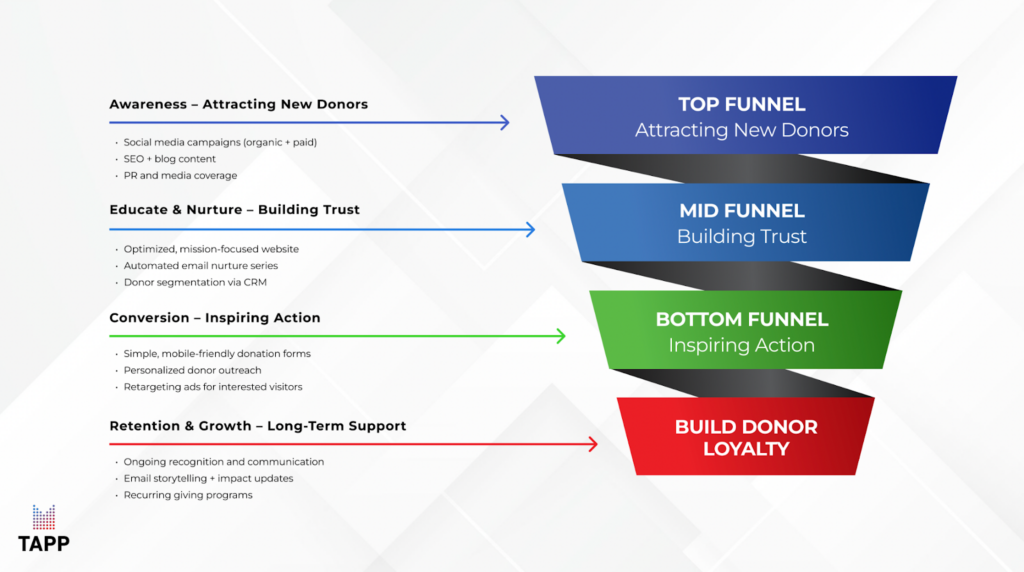
Social Media Should Function as a Funnel
Instead of thinking in terms of individual posts, think in terms of a system:
- Awareness – Introduce your organization to new audiences
- Engagement – Share content that builds understanding and connection
- Retargeting – Stay visible and reinforce your message
- Conversion – Drive action (donations, sign-ups, attendance)
Without paid distribution and follow-up, this process breaks down.
A Smarter Approach
Nonprofits don’t need to do more. They need to do what they’re already doing—better.
That means:
- Creating fewer, higher-quality posts
- Identifying top-performing content
- Investing modest budgets to promote key messages
- Using targeting to reach the right audiences
- Measuring results and refining strategy
Final Thought
Nonprofits operate with limited resources and high stakes. Every hour and every dollar matters.
If you are investing in content creation but not in distribution, you are not getting the full value of your work.
Social media can absolutely grow your reach, your audience, and your funding—but only if you treat it as a strategic, paid channel.